BankAmericard — Draft Section
Draft for manual evaluation. Written to follow the tone, style, and skeleton of the Diners Club section (launch ad → era-opening line → context → the pioneering insight → founding story → mechanics → technology → fraud → rollout numbers → legacy close). Suggested improvements to the Diners Club section are at the bottom of this file.
BankAmericard
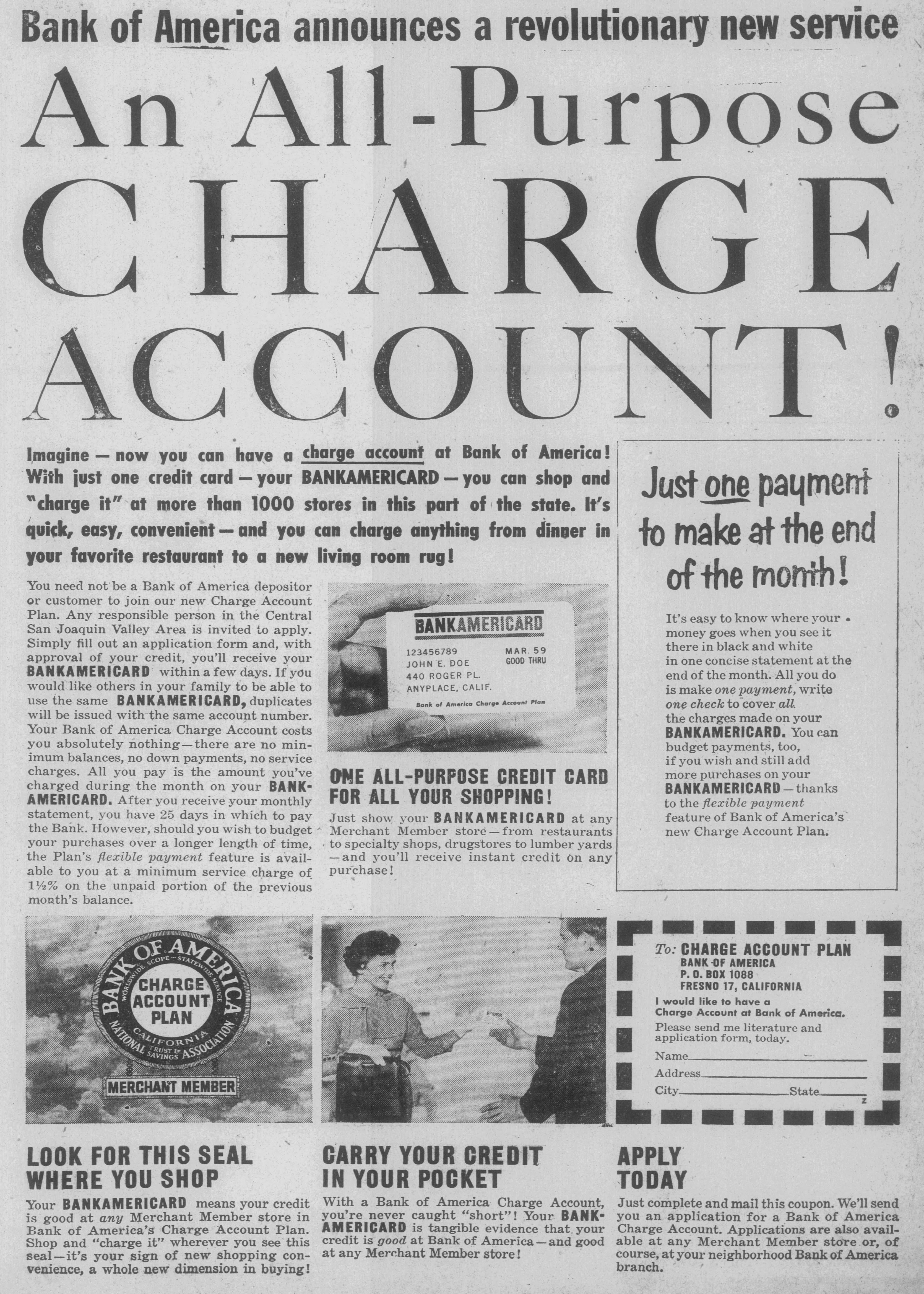
The era of the modern bank credit card — a universal card with revolving credit attached — began with the BankAmericard in 1958.
Banks were, at first glance, unlikely pioneers. At the beginning of the 1950s, most banks did not promote consumer credit of any kind. Unsecured consumer lending was considered the domain of merchants and less-than-reputable finance companies; as the credit historian Lewis Mandell put it, “If a bank had a consumer loan department, it was often found in the basement where no one could see the furtive borrower.” One critic complained that early bank card experiments were “lowering banking’s image by engaging in an activity more properly associated with pawn shops.”
Some smaller banks had experimented anyway. Of the roughly one hundred bank card schemes launched in the US after 1947, only 27 were still operating by 1958. The failures shared a structural problem: a card system needs a critical mass of both cardholders and merchants, and American banking regulations of the era prohibited banks from branching across state lines — in many states, even across a city. Most bank cards were doomed to remain neighborhood products.
There was one bank, however, that had the scale, the capital, and — crucially — the corporate culture to make it work: Bank of America. Founded by A. P. Giannini, the son of an Italian immigrant who prided himself on serving “the little fellow,” Bank of America had built its empire on precisely the consumer lending other banks considered beneath them. It financed televisions, refrigerators, and automobiles on installment; at one point in the 1950s it held a $60 million portfolio made up largely of $200 refrigerator loans. And it operated in California, a state that permitted statewide branching. With some 700 branches, $5 billion in assets, and a banking relationship with well over half the state’s residents, it was the largest bank in the world — known locally, only half-jokingly, as MotherBank.
"We were always a leader in installment credit. Anything you could buy on time we financed... the credit card was just a natural extension of that."
Unlike Diners Club, the BankAmericard did not spring from a (real or invented) flash of inspiration at a restaurant table. It emerged from a think tank. In 1956, a middle manager named Joseph Williams convinced the bank to set up a small Customer Services Research Department, and there was never much doubt about what management expected it to produce: the bank had already studied the idea of an all-purpose credit card three times before.
Williams did not invent much from scratch either. He had friends at Sears and Mobil Oil who quietly let his team observe their credit operations, and he patterned the new system directly on theirs. From that research came features that would remain essentially frozen for decades: a 25-day grace period during which no interest accrued, and an interest rate of 1½ percent per month — 18 percent a year. There was no black magic involved. If those numbers were good enough for Sears, with its fifty years of credit experience, they were good enough for Bank of America.
The pioneering insight behind the BankAmericard was what Williams did with those borrowed parts. He saw that a card could work in two ways: as a convenience device, like the Diners Club card, or as a generator of instant personal loans. He structured the BankAmericard to do both, at the cardholder’s option. When the bill arrived, the customer alone decided whether to pay in full and owe nothing, or pay in part and finance the rest. Where a traditional installment loan meant sitting across a desk from a loan officer — often with your spouse, co-signing the note — the BankAmericard was self-service credit. The financing decision moved from the bank to the cardholder, and the line between buying and borrowing quietly blurred.
Like every card system before it, the BankAmericard faced the chicken-and-egg dilemma: merchants would not pay to accept a card nobody carried, and nobody would carry a card no merchant accepted. Williams’s solution was blunt. Rather than recruit cardholders, he would create them.
The bank called it “The Drop.” In the weeks leading up to September 18, 1958, Bank of America mailed roughly 60,000 unsolicited, ready-to-use BankAmericards to households in Fresno, California. No applications, no credit checks — the cards simply arrived in the mail, as if dropped from the sky. Fresno was chosen partly because 45 percent of its families already banked with Bank of America, and partly because it was isolated enough that if the card flopped, the damage to the bank’s reputation would be contained. The launch was deliberately low-key; the Fresno Bee sandwiched six paragraphs about it between the business briefs and the livestock report.
Nothing about how a mass-market credit card should work was obvious in 1958, and Williams’s team was making it up as they went. They decided, on little more than intuition, that credit limits should range from $300 to $500. Merchants would pay a 6 percent discount on each transaction and $25 a month to rent an imprinter. Each merchant was assigned a floor limit — typically $25 to $100 — below which no authorization was needed; above it, the merchant had to telephone the bank for approval, a process that was entirely manual and exceedingly slow.
The card itself was plastic with embossed account information, similar to the new American Express card, and the imprinter transferred that information onto the sales draft, reducing copy errors. Early imprinters had no wheels for the date or amount, so merchants wrote those in by hand and the customer signed to authorize the charge. The back office, however, was computerized from the very beginning — Bank of America had been the first bank in America to install a computer, an IBM 702, in 1955 — and the sales drafts were designed for the machine: each had a punch card as its bottom layer, punched with the transaction details upon deposit.
One more piece of the system deserves attention, because it solved a problem Diners Club never had. Diners Club could hand its cardholders a printed list of participating establishments; the BankAmericard’s merchant base would be far too large and diverse for that. How would a cardholder know where the card was accepted? The answer was a mark: three colored bands — blue, white, and gold — printed on the card and on signs hung in merchants’ windows. The card identified the cardholder to the system; the mark identified the merchant to the cardholder. It is a design decision still visible in every card network logo on every shop door today.
For merchants, the pitch was the same one Diners Club had made to restaurateurs, and it landed hardest on small shopkeepers drowning in their own charge accounts. The large retailers — Sears, J.C. Penney, Montgomery Ward — refused to accept the card, seeing the bank as a poacher on their proprietary credit operations. But the small merchants came around. Larkin recalled visiting one drugstore owner:
"He had three girls working on Burroughs bookkeeping machines, each handling 1,000 to 1,500 accounts. I looked at the size of the accounts: $4.58. $12.82. And he was sending out monthly bills on these accounts. Then the customers paid him maybe three or four months later. Think of what this man was spending on postage, labor, envelopes, stationery! His accounts receivables were dragging him under."
Why consumers bothered is a more interesting question. Checks were accepted at local shops, merchants already extended credit to regulars, and anyone who qualified for a BankAmericard could have qualified for an installment loan. Part of the answer was the impersonality of self-service credit; part was consolidation — one card and one bill instead of a dozen store accounts. But mostly, the card was a novelty in an age of novelty. Just as Americans spent hours staring at the test pattern of their new televisions, the citizens of Fresno gathered around the checkout counter to watch someone pay with a BankAmericard.
The cautious experiment did not stay cautious for long. Within months, the bank learned that a competitor was preparing to drop a rival card in San Francisco — Bank of America’s own back yard — and all restraint was abandoned. Cards were rushed to Modesto and Bakersfield, then San Francisco, Sacramento, and Los Angeles. Within 13 months, 2 million BankAmericards were in circulation and more than 20,000 merchants had signed up. In a single move, Bank of America had created more cardholders in California than Diners Club had ever had nationwide.
Then came the bill. Williams had assumed delinquencies would run around 4 percent, the rate on the bank’s installment loans; they hit 22 percent. He had assumed collections “would never be a problem” and had not bothered to set up a collections department. Fraud was rampant: thieves learned to decipher the floor-limit codes on stolen cards and racked up strings of small purchases that never triggered an authorization call, and burglars stole unembossed cards from the bank’s warehouse and offered to sell them back — which, fearing worse, the bank sometimes did. Fifteen months after the Drop, the program had officially lost $8.8 million; with hidden costs like advertising and overhead, the real figure was closer to $20 million. Williams resigned. Newspapers, congressmen, and at least one Sunday pulpit denounced the bank for mailing people a debt machine they had never asked for. (The practice of unsolicited card mailings, which banks used to scatter some 100 million cards across the country, was finally outlawed in 1970.)
What happened next mattered more. Instead of abandoning the program as so many banks had before it — by one account, on the reasoning that “every conceivable mistake had already been made” — Bank of America handed the card to its installment loan men. A collections department was built, an anti-fraud unit established, dishonest merchants dropped, and the merchant discount cut to as low as 3 percent to win over reputable stores. By May 1961 the BankAmericard was profitable, a fact the bank kept quiet: the publicity around its losses was conveniently deterring every other bank from trying.
The final act turned a California card into a global network. The card was profitable but trapped — the same branching laws that had killed the small bank cards prevented Bank of America from following its customers across state lines. So in 1966 it did the next best thing: it licensed the program, charging banks in other territories $25,000 plus royalties for the franchise, the accounting software, and the brand. Barclays became the first international licensee that same year.
Licensing created something no payment card system had needed before: interchange. For the first time, the bank that issued the card and the bank that served the merchant could be different institutions, and they needed a way to clear and settle transactions between them — acquiring banks mailed sales drafts to issuing banks for payment, less a fee now called the interchange reimbursement fee. The banks left out of the franchise responded by forming a rival cooperative, Interbank, which in 1969 bought the name “Master Charge” and its overlapping-circles mark — later MasterCard.
In 1970, under pressure from its franchisees, Bank of America spun the system off into an independent, member-owned organization: National BankAmericard Incorporated (NBI). In 1976, NBI renamed itself Visa. The blue, white, and gold bands first drawn to hang in Fresno shop windows had become the flag of the largest payment network on Earth.
Suggested improvements to the Diners Club section
Notes only — not applied to the article.
-
Name consistency. The heading and captions use “Diner’s Club” while the body text uses “Diners Club.” The company’s actual name had no apostrophe — suggest normalizing to “Diners Club” throughout (heading, captions, gallery titles, and the Amex section too).
-
Founder’s name spelling. Body text says “McNamara” (correct), but both blockquote citations say “MacNamara.” Fix the cites.
-
The Franklin National claim (revolving credit). The section ends by saying revolving credit cards began “with Franklin National Bank in 1951.” Per the sourcing (Struble, via the book), the Franklin plan likely did not offer revolving credit — it was closer to a T&E card, and the “first revolving credit card” label is contested. Revolving credit itself came from department stores (L. Bamberger & Co., 1947; J. L. Hudson’s added the interest-free period in 1956). Suggest hedging: Franklin was arguably the first bank charge card, while revolving credit was a department-store invention that bank cards later absorbed. This also conflicts slightly with the Charg-It section (line ~588), which credits Franklin as “the first bank program to actually use a credit card” — worth making the two mentions tell one consistent story.
-
Section ordering vs. the Amex transition. The American Express section currently ends with a paragraph that transitions into BankAmericard (“The true revolution… would come from… Fresno”), but American Express appears after the BankAmericard section in the file. Either move the Amex section before BankAmericard (its launch on October 1, 1958 was only two weeks after the Fresno drop, and charge cards → credit cards is the cleaner narrative arc), or rewrite that closing paragraph. The draft above assumes the section order becomes Diners Club → American Express → BankAmericard; if you keep the current order, the draft’s opening line still works but the Amex transition paragraph should move or change.
-
A forward-pointer on technology. The Diners Club section mentions floor limits and hot lists as primitive anti-fraud measures. A single sentence noting that these manual mechanisms would strain badly once cards went from thousands of affluent diners to millions of ordinary consumers would set up the BankAmericard fraud story (and, later, electronic authorization) nicely.
-
“Country club billing” payoff. The section mentions Diners Club mailing back original signed receipts but doesn’t say why that detail matters. One clause — that this practice persisted into the bank card era and became a real processing bottleneck until descriptive billing replaced it — would tie the detail to the article’s technology thread.